
Estimate enterprise value using the discounted cash flow method. Combine historical data with the forecast and see how assumptions affect the valuation.
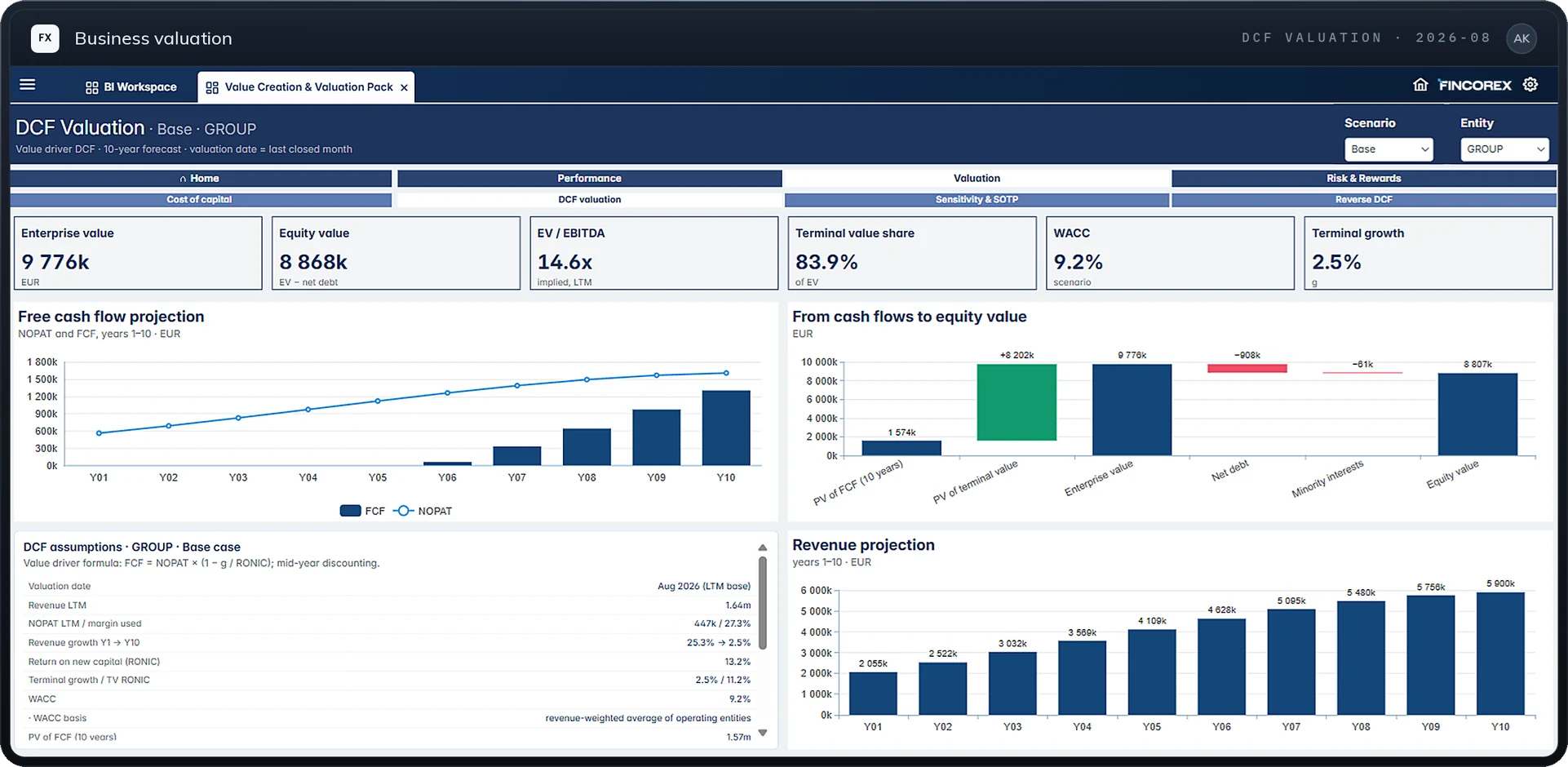
A reference point for the forecast.
Revenue, costs and margins in the years ahead.
Including CAPEX in cash flows.
Impact of changes in inventories, receivables and operating payables.
Free cash flow to the firm (FCFF).
Converting future cash flows to present value.
The value of cash flows beyond the explicit forecast period.
The sum of discounted cash flows and terminal value.
Comparing results at different discount rates.
In this simplified example, the company generates PLN 10m of free cash flow per year. The table shows the bridge from operating profit after tax to cash flow in the first forecast year.
Simplified example · illustrative data
With the same cash flows and zero growth after the forecast period, a higher discount rate lowers the present value of the business.
Only the discount rate changes in each scenario. Illustrative data.
Use historical data as the reference point for the forecast.
Include operating profit, investments and changes in working capital.
Discount the cash flows and the terminal value.
In this example, the present value of five years of cash flows is PLN 37.91m. The discounted value of cash flows beyond that period adds another PLN 62.09m.
Illustrative data
The DCF method values a business as the sum of future free cash flows discounted to the valuation date at a rate reflecting the cost of capital (WACC).
It is the value of cash flows generated after the explicit forecast period, discounted to present value. It often accounts for a significant part of the valuation.
No. Enterprise value (EV) relates to total capital. To get equity value, net debt is deducted from EV.
It shows how the valuation changes under different assumptions – e.g. the discount rate – with all other parameters unchanged.
As a proof of concept, we’ll rebuild your reporting or planning model in Fincorex® and show it to you at our next meeting.
Book a demo